Saturday, October 29, 2005
Rob Smith moves to UCL


Thursday, October 27, 2005
Norm Packard rides again
Tag and a squiggle
More raves for the Teaching Company
Sunday, October 16, 2005
Educating a penguin, part 5
One thing that made the application process easy was the existence of the Common Application. The common app is both a paper and electronic application system that allows you to fill out a single application for 277 participating schools. All schools in our list except Northwestern and Illinois take the common app. Max and I used the electronic version, and the web site was well designed and easy to use. Some of the schools required supplements beyond the common app, and the web site had a nice tab for handling those as well.
Max's schools divide into two many categories, research universities and small colleges. All of the small colleges are listed in Loren Pope's helpful book, Colleges that Change Lives. Max and his mom visited Ursinus last week, and Max stayed overnight in the dorms and went to class, had an interview, and went on a tour. I very much like the small schools we have visited. The campuses exude an enthusiasm for undergraduate education that just doesn't exist at a research university. Tours of buildings drip with evidence of student research and extracurricular activity.
Right now we're in the middle of applying for scholarships. Much of the money available today is based on need, but we're concentrating on merit aid. The Ivies and Northwestern don't give any merit aid, but WUSTL and Illinois do, as do the CTCL schools. Some schools include students in the merit pool merely by applying, and others require separate scholarship applications. Max was named a National Merit Semifinalist, and that award requires a special application to be named a finalist and to be eligible for other awards connection to it.
There are a variety of sites that provide very helpful information on scholarships. My favorite is Fastweb run by monster.com. It has tabs for scholarship, college, and job & internship searches. The interface is intelligently arranged and the site is easy to use. We've gotten good tips on scholarships from the site and have followed up on a number of them.
I don't remember the search for college being this hard. I applied to one school, Michigan, and went there. I don't remember it being hard to get in. I took one admissions exam (the SAT), one time. Today, the process is complex, the competition is stiff, and the examinations are endless. Collegebound students today face a gauntlet that has grown beyond reason, but wise parents and students will learn and play the game because the value of a college education is so high.
Y-p Chen's new book is available
TITLE: Extending the Scalability of Linkage Learning Genetic Algorithms: Theory & Practice
AUTHOR: Ying-ping Chen
PUBLISHER: Springer, 2005, XX, 120 p. 37 illus., HardcoverISBN: 3-540-28459-1
ABOUT: Genetic algorithms (GAs) are powerful search techniques based on principles of evolution and widely applied to solve problems in many disciplines. However, most GAs employed in practice nowadays are unable to learn genetic linkage and suffer from the linkage problem. The linkage learning genetic algorithm (LLGA) was proposed to tackle the linkage problem with several specially designed mechanisms. While the LLGA performs much better on badly scaled problems than simple GAs, it does not work well on uniformly scaled problems as other competent GAs. Therefore, we need to understand why it is so and need to know how to design a better LLGA or whether there are certain limits of such a linkage learning process. This book aims to gain better understanding of the LLGA in theory and to improve the LLGA's performance in practice. It starts with a survey of the existing genetic linkage learning techniques and describes the steps and approaches taken to tackle the research topics, including using promoters, developing the convergence time model, and adopting subchromosomes.KEYWORDS: Chromosome Representation, Genetic Algorithms, Genetic Linkage, Learning Techniques, Soft Computing
TABLE OF CONTENTS
Foreword by David E. Goldberg
Preface
1. Introduction
2. Genetic Algorithms and Genetic Linkage
3. Genetic Linkage Learning Techniques
4. Linkage Learning Genetic Algorithm
5. Preliminaries: Assumptions and the Test Problem
6. A First Improvement: Using Promoters
7. Convergence Time for the Linkage Learning Genetic Algorithm
8. Introducing Subchromosome Representations
9. Conclusions
BOOK INFORMATION
http://www.springeronline.com/3-540-28459-1
ORDER IT ON AMAZON.COM
http://www.amazon.com/gp/product/3540284591
Tuesday, October 11, 2005
Open BEAGLE 3.0.0 released
Open BEAGLE is a C++ evolutionary computation framework. It provides a high-level software environment to do any kind of evolutionary computation, with support for tree-based genetic programming, bit string, integer-valued vector and real-valued vector genetic algorithms, evolution strategy, co-evolution, and evolutionary multi-objective optimization.
Important feature enhancements of version 3.0.0:
* Integer-valued vector GA representation
* Initialization/crossover/mutation operators for shuffled indices integer-valued vector GA
* Travelling salesman problem example that illustrates the integer-valued vector representation
* GP primitives with dynamic number of arguments
* Dynamic selection weight of GP primitives for initialization and mutation
* Support for individuals with variable number of automatically defined functions (ADFs)
* Support for evolutionary module acquisition in the GP framework
* GP ephemeral random value mutation operator
Thursday, October 06, 2005
Deb gets Bhatnagar Award
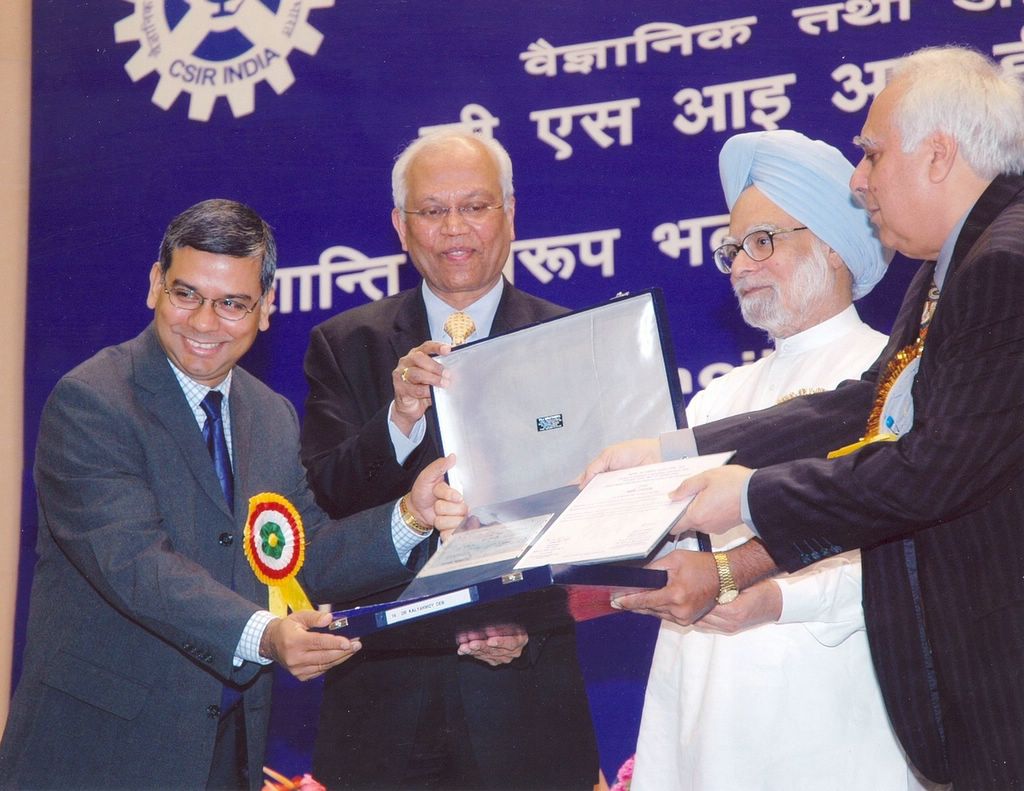
Kalyan Deb receives Bhatnagar prize from Prime Minister of India

On September 28, 2005, IlliGAL alum, Kalyanmoy Deb (1st on left) received the prestigious Bhatnagar award from Prime Minister Manmohan Singh (2nd from right). More information is available here.


